We are currently still building up the English documentation; not all sections have been translated yet. Please note that there may still be German screenshots or links to German pages even on pages that have already been translated. This guide mostly addresses English speaking users in Germany.
Video
Getting started: Bills of materials

In this video we explain how bills of materials work in JTL-Wawi.
Creating bills of materials in JTL-Wawi
Your task/initial situation
General info on bills of materials
In JTL-Wawi, bills of materials (BOMs) are items that are comprised of at least two individual items. A BOM can have an indefinite number of components in varying quantities.
Delivery time:
The delivery time of a BOM depends on the availability of its individual components. Only inventory items will be taken into account. This means that the option Inventory management active must be enabled for at least one component. Otherwise the shipping status cannot be displayed.
The delivery time depends on the availability of all required components. It must be possible to deliver the BOM at least once. Consequently, you might not be able to deliver the BOM even if the stock level of individual components is higher than 0 because the BOM requires a larger amount of a specific component.
When a BOM cannot be processed due to a lack of stock, the time that is needed to procure the components from the supplier will be taken into account if Allow negative stock is enabled.

The delivery time depends on the component with the longest delivery time.
Please note: When you enable the option Set manually and enter a value into the field, the delivery time of the supplier will be ignored. Instead, the entered value will be used as the procurement time. In the example below, the delivery time would change to 5 days.

Availability:
The stock level of a BOM is therefore directly linked to the stock levels of its components. The lowest stock level is the decisive factor. This means that when a BOM consists of two components and the first component is in stock five times and the second is in stock three times, the BOM will only be displayed as being available three times.
Price:
The total price of the BOM can be set independently of the price of the individual components. To help you determine the total price, the average net purchase price of a BOM in the item master data is calculated from the purchase prices of the individual components.
Please note that you must first change the global settings for this. Read more on: Adjusting global settings.
Storage/Pick lists:
In JTL-Wawi, BOMs are only combined during the picking process. Therefore, up until delivery, it does not matter whether you sell its components individually or as a BOM. The components of a bill of materials also do not necessarily have to be stored in the same place. It is possible to pre-pack BOMs. However, if you do so, you will not be able to sell the components individually.
Notes:
Step 1: Creating components
This step is only necessary if the individual components that you want to be part of the BOM have not yet been created as individual items.
- Create all items in JTL-Wawi that you want to be part of the BOM, e.g. the bar, discs, and screws.
- Set the price for each item and decide if you want inventory management to be active and on which platforms you would like to list the item.
In this step, you can of course make use of all the regular options for creating an item. In JTL-Wawi, a component does not differ from a standard item. However, a component cannot be a parent item, a configuration item or a BOM itself. Child items, on the other hand, can be components of a BOM.
Step 2: Creating bills of materials
- Create an item in JTL-Wawi that will later be sold as a BOM.
- In the item master data, go to the tab BOM/Configurator.
- Enable the option The item is a BOM.. Then click Add. The dialogue box Searching for items opens.

- Via the category structure or the search filters, select the line items you wish to add to the BOM as components. Select the line items and click Add from above. You can also add child items to the BOM in this way.
Im Dialogfenster Artikel suchen wählen Sie Artikel aus Ihrem JTL-Wawi-Bestand aus. Das Fenster erscheint immer dann, wenn Sie mehrere Artikel einer Liste hinzufügen können.
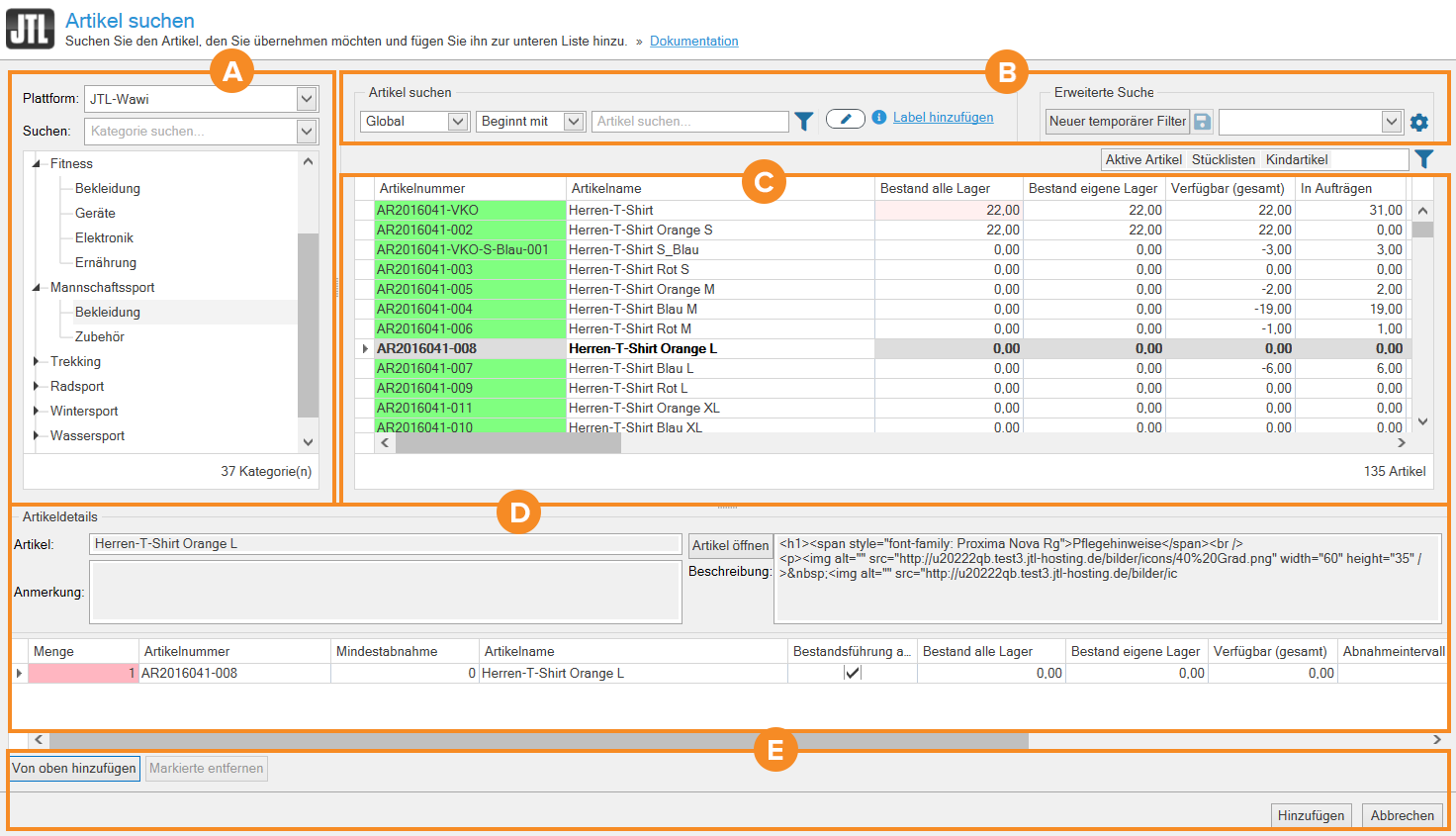
Bereich A: Kategoriebaum
Der Kategoriebaum entspricht demselben Kategoriebaum, den Sie in der Artikelverwaltung angelegt haben.
Plattform: Wählen Sie in diesem Dropdown-Menü aus, auf welcher Plattform Sie die gewünschten Positionen suchen möchten.
Suchen: Geben Sie in dieses Suchfeld einen bestimmten Kategorienamen ein.
Bereich B: Suchen & Filtern
Artikel suchen
Erstes Dropdown-Menü: Wählen Sie in diesem Dropdown-Menü, ob Sie die Artikel Global, in Oberkategorien oder in Unterkategorien suchen möchten.
Zweites Dropdown-Menü: Wählen Sie in diesem Dropdown-Menü zwischen Beginnt mit und Enthält. Diese Optionen beziehen sich auf das nebenstehende Textfeld, in dem Sie Angaben zum Artikel machen können.
Textfeld: Machen Sie in diesem Suchfeld Angaben zum Artikel wie beispielsweise die EAN, HAN oder UPC.
Erweiterte Suche
Neuer temporärer Filter: Über diese Schaltfläche gelangen Sie in das Dialogfenster Eigenen Filter erstellen. In diesem Dialogfenster können Sie einen Filter erstellen und als Suchvorlage speichern. Der angelegte Filter kann anschließend im Dropdown-Menü neben der Schaltfläche Neuer temporärer Filter ausgewählt werden.
Filtersymbol: Über das blaue Filtersymbol können Sie auswählen, welche Art von Artikeln Sie sich anzeigen lassen möchten. Sie können hier beispielsweise Kindartikel aktivieren, um diese in der Übersicht sehen zu können.
Bereich C: Auswahlvorschlag
In dieser Übersicht sehen Sie alle Artikel, die entweder zu Ihrer Suche passen oder sich in der Kategorie befinden, die Sie ausgewählt haben. Doppelklicken Sie auf den gewünschten Artikel, um ihn in die Auswahl zu übernehmen. In der Übersicht sehen Sie zahlreiche artikelbezogene Informationen. Klicken Sie mit einem Rechtsklick auf einen beliebigen Spaltenkopf und öffnen Sie den Spalteneditor. Im Spalteneditor können Sie bestimmen, welche Artikel-Informationen Sie sehen.
Bereich D: Artikeldetails
Artikel: Zeigt den Namen des ausgewählten Artikels.
Anmerkung: Sofern in den Artikelstammdaten hinterlegt, zeigt dieses Feld die Anmerkung zum ausgewählten Artikel.
Artikel öffnen: Über diese Schaltfläche können Sie die Artikelstammdaten des ausgewählten Artikels öffnen.
Beschreibung: Sofern in den Artikelstammdaten hinterlegt, zeigt dieses Feld die Beschreibung zum ausgewählten Artikel.
Bereich E: Funktionsleiste
Von oben hinzufügen: Wählen Sie einen Artikel aus dem Auswahlvorschlag aus und klicken Sie auf diese Schaltfläche, um ihn der Auswahl hinzuzufügen.
Markierte entfernen: Entfernt alle markierten Artikel aus der Auswahl.
Hinzufügen: Schließt das Dialogfenster Artikel suchen und kehrt zum vorherigen Dialogfenster zurück, in das die Auswahl übernommen wurde.
Abbrechen: Schließt das Dialogfenster Artikel suchen und kehrt zum vorherigen Dialogfenster zurück, ohne dass eine Auswahl übernommen wurde.
- In the column Quantity, indicate the quantity of an item, you would like to add to the bill of materials.
- Click Add to return to the item master data.

- Close the item by clicking Save.
Display options for bills of materials in JTL-Shop
For more information on this topic refer to the JTL-Shop documentation:
Video
Getting started: Bills of materials
In this video we explain how bills of materials work in JTL-Wawi.
Related topics